Reservation
Domaine Des Vanneaux Golf & Spa MGallery. Take a breathtaking breath of fresh air at the gateway to Paris. Our hotel is an invitation to relax and let go, where everything is brought together for unforgettable moments.
Reservation
One of the finest golf courses in the Paris region, ranked among Europe's top 50. Built on a hilly, wooded site, it offers panoramic views over the region and allows golfers to recharge their batteries in the countryside.
Reservation
Our 2 restaurants will cater to your every whim.
Le 19, located in the club house, offers French cuisine, combining local flavours.
Le Piaf, the restaurant of the hotel "le Domaine des Vanneaux", offers bistronomic cuisine.
 Golf de l'Isle Adam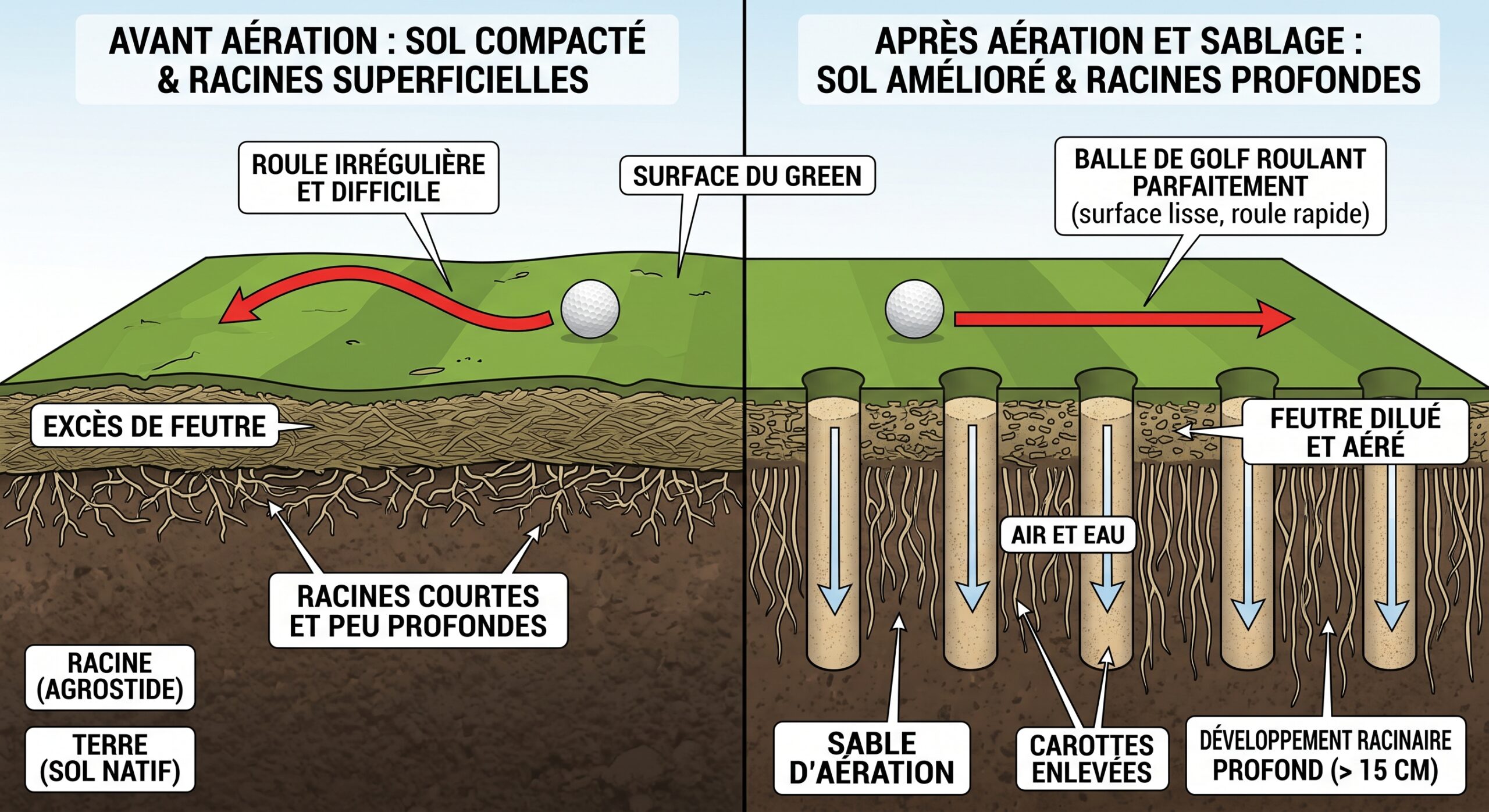
A green isn’t a carpet. It’s a living surface, made up of thousands of blades of bentgrass or bluegrass, with a network of roots beneath the surface that needs air, water, and nutrients to stay healthy. The problem is that every activity leaves an invisible mark: repeated foot traffic from players, frequent close mowing, watering, rain, and frost eventually compact the soil. As a result, the soil structure becomes compacted, air circulation is reduced, the roots wither, and the turf loses its vigor.
That is exactly what aeration is designed to correct. By drilling holes in the soil at regular intervals, the field crew literally reopens the space the roots need to grow deeper.
Behind this somewhat technical term lie very tangible benefits for gameplay quality:
A well-ventilated green is a green that holds up better in the middle of August, when high traffic and heat go hand in hand.
After aeration, sand is applied to the green. You might think it’s just used to fill in the holes. In reality, it plays a much broader role in the soil structure:
| What Sand Does | Why It Matters for Your Game |
|---|---|
| It keeps the ventilation holes open | Air and water continue to circulate through the soil profile |
| It improves drainage | Fewer puddles, a firmer surface after it rains |
| It evens out the soil structure | More consistent support for the roots, with each application |
| It breaks down organic matter | Less felt, less excessive water retention |
| It evens out the surface once it has been mixed in | A smoother, more predictable ride |
Yes, the amount of sand may seem overwhelming on the day it's laid. But it is then brushed in, worked into the surface, and absorbed by it. The visual disruption and disruption to traffic last only a few days.
During the growing season, these treatments are performed on the greens about once a month, with the depth and frequency adjusted according to the weather and soil conditions. This frequency is consistent with practices observed on other French courses, where aeration is ideally performed on the fairways and tees once a year and on the greens once a month. Not all aeration sessions are the same: some involve substantial sanding, while others are lighter, depending on the objective at that point in the season.
The real challenge for a field team is coordinating the schedule. Aeration is particularly effective in the spring and early fall, especially for curbing the spread of annual bluegrass, but the various tournaments don’t always allow us to perform this task at the ideal time. That’s why our team works around the tournament schedule and the Grand Prix to find the best possible windows—between events and outside of major tournament weekends.
There is a long-term goal behind all of this: to change the composition of the turf itself. Aeration and sanding—by improving oxygenation, water infiltration, and root development—create conditions more favorable to bentgrass, that fine, dense grass that is particularly sought after on greens. The goal is not to eliminate annual bluegrass all at once, but to strengthen, month by month, the competitiveness of bentgrass against it.
A green that’s better suited to bentgrass is a denser, more resilient, and higher-performing green. And this surface quality is no small matter: it’s one of the reasons our rolling, wooded course—designed by Ronald Fream—has earned its place among the top 18-hole courses.
During heat waves, the green is subjected to significant stress, and compacted soil limits root function. Proper aeration helps the turf better withstand heat waves, droughts, and heavy summer traffic. It also plays a preventive role against certain diseases that are exacerbated by excess moisture or poor air circulation in the soil. Aeration and sanding are not a substitute for treatment once a disease has already taken hold, but they significantly reduce the risk of it developing.
In the days following maintenance, it is normal to see small holes, visible sand, slight unevenness, and a temporarily less consistent roll. There is no cause for concern: the grass will gradually fill in the openings, and the sand will settle into the surface. The green will regain its appearance, firmness, and rolling quality within a few days.
In the meantime, there’s nothing stopping you from enjoying the rest of your day at the club. If your putts haven’t been falling as you’d hoped, head out to the patio to relax with something from the 19 menu while you wait for the green to do its thing.
Aeration about once a month, carefully controlled sanding—and the entire season benefits: healthier greens today, better-performing greens tomorrow. This minor inconvenience lasting just a few days is the price we pay for long-lasting quality of play on a course nestled in a preserved natural environment.